Audacity vs VLC Media Player: At a Glance
Audacity is the better choice for audio creation and editing workflows because it provides multi-track recording with professional effects processing; VLC Media Player suits media consumption and format compatibility needs because it plays virtually any audio or video file without codec hunting. Both programs operate as free, open-source solutions in the multimedia software space, but they serve fundamentally different purposes. Audacity focuses exclusively on audio production—recording podcasts, editing music, and applying effects like noise reduction and equalization. VLC Media Player excels at playback across hundreds of formats, handling everything from damaged video files to DVD ripping and network streaming. The audacity vs vlc media player debate ultimately depends on whether you need to create audio content or simply consume existing media files.
Where Audacity Wins
Professional Audio Editing Capabilities
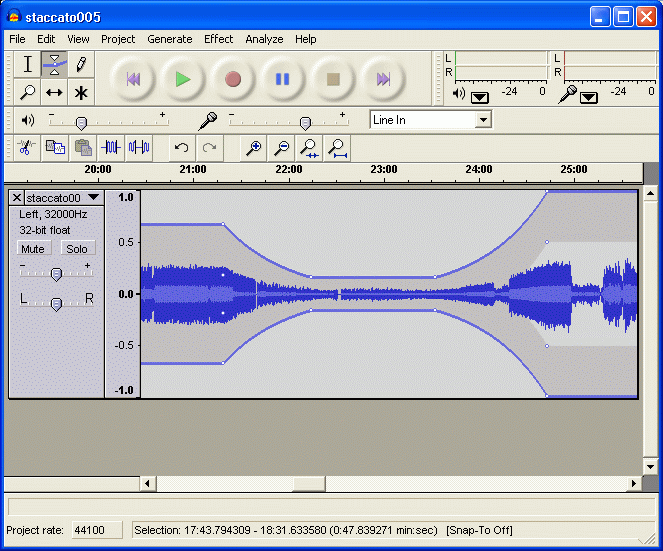
Audacity delivers thorough multi-track recording that VLC simply doesn't offer. You can record multiple instruments simultaneously through separate input devices, then apply sophisticated effects like 31-band equalization and spectrum analysis. The Generate menu creates tones, silence, and white noise programmatically. Time-stretching changes tempo without affecting pitch, while pitch-shifting alters tone without changing speed—capabilities essential for music production that VLC lacks entirely. The waveform display makes precise edits intuitive, letting you visualize audio data for surgical editing precision.
Audio Format Creation and Export Control
Where VLC focuses on playback compatibility, Audacity provides granular export control for audio creation workflows. Custom bitrate settings range from 32 kbps voice recordings to 320 kbps music distribution quality. The application supports lossless formats like FLAC and WAV for professional archiving, plus OGG Vorbis for open-source lossy compression. Export rendering processes entire projects with applied effects, creating final masters that VLC can only play back. This codec flexibility makes Audacity indispensable for content creators who need specific audio formats for different distribution channels.
Where VLC Media Player Wins
Universal Format Compatibility
VLC Media Player handles hundreds of audio and video formats that Audacity can't touch. Built-in decoders support H.264, H.265, VP9, AV1, and legacy containers like MKV, MP4, and AVI without external codec installations. The player reads damaged or incomplete files that crash other applications, making it valuable for recovering partial downloads. Subtitle support includes SRT, VTT, and SSA formats with customizable positioning. This thorough format coverage eliminates the codec hunting that plagues other media players, particularly for exotic or proprietary formats.
Hardware Acceleration and Performance
VLC uses DXVA2, D3D11, and VAAPI hardware acceleration to reduce CPU load during H.264 and H.265 playback—technology that Audacity's software-only processing can't match. The player renders 1080p content smoothly on modest hardware while consuming just 50-150MB RAM during standard playback. Hardware acceleration proves crucial for 4K streams and high bitrate content where software decoding would overwhelm older systems. Background transcoding operations utilize multiple CPU cores efficiently without blocking playback controls, delivering superior performance for media consumption workflows.
Head-to-Head: Feature Comparison
| Aspect | Audacity | VLC Media Player |
|---|---|---|
| License | GPL v2 (Free) | GPL (Free) |
| Platforms | Windows, macOS, Linux | Windows, macOS, Linux, mobile |
| Primary function | Audio editing/recording | Media playback/streaming |
| Supported formats | Audio only (WAV, MP3, FLAC, OGG) | 200+ audio/video formats |
| Hardware acceleration | None | DXVA2, D3D11, VAAPI |
| Multi-track capability | Yes (unlimited tracks) | No (playback only) |
| Effects processing | 50+ built-in effects | Basic filters only |
| Network streaming | No | HTTP, RTSP, UDP protocols |
| Resource footprint | 2GB RAM minimum | 256MB RAM minimum |
| Learning curve | Moderate (audio editing concepts) | Minimal (familiar controls) |
The format support gap represents the widest divide between these applications. VLC's 200+ format compatibility versus Audacity's audio-only focus determines which tool fits your workflow. VLC's hardware acceleration also provides significant performance advantages for video playback that Audacity's CPU-dependent processing cannot match.
Verdict by Use Case
- Podcast production and editing → choose Audacity because multi-track recording lets you layer intro music, voice tracks, and sound effects with precise timing control
- Playing downloaded movies with subtitles → choose VLC Media Player because built-in subtitle support and universal format compatibility handle any video file without codec issues
- Converting audio between formats for distribution → choose Audacity because custom bitrate export settings and lossless format support provide professional conversion control
- Long-term media library management across multiple devices → choose VLC Media Player because cross platform consistency and broad format support ensure your entire collection remains accessible regardless of source or container format
Common Questions
Can VLC Media Player edit audio files like Audacity? A: No, VLC Media Player is designed purely for playback and basic transcoding, not audio editing. While it includes a 10-band equalizer and basic audio filters, VLC lacks multi-track recording, waveform editing, or effects processing capabilities that define audio editing software.
Does Audacity play video files with synchronized audio? A: Audacity extracts audio tracks from video containers like MP4 and AVI but discards all visual data during import. The application focuses exclusively on audio editing and cannot display video content alongside audio tracks, making it unsuitable for video editing workflows that require visual synchronization.
Which program requires fewer system resources for basic media tasks? A: VLC Media Player demands significantly less RAM (256MB minimum versus 2GB) and launches faster than Audacity. For simple media playback, VLC's lightweight footprint makes it ideal for older hardware or systems running multiple applications simultaneously, while Audacity's resource requirements reflect its complex audio processing capabilities under the open source model.